Holo3.1
June 1st, 2026
Holo3.1: Fast & Local Computer Use Agents
Last March, we released Holo3, our state-of-the-art computer-use model. Adoption was immediate. Developers, enterprises, and partners started deploying Holo3 across a wide range of workflows, from browser automation and business software to internal tools and desktop applications. As adoption grew, we realized performance alone was no longer enough.
Users want to run the same computer-use capabilities across desktop and mobile environments, with seamless integration with different agent frameworks. They want deployment flexibility, from cloud inference to fully local execution on end-user devices.
This is why we are releasing the Holo3.1 family. Holo3.1 improves robustness across the three dimensions that matter most in production: environments (web, desktop, mobile), agent frameworks, and deployment targets: for the first time, we release quantized checkpoints optimized for local inference, including FP8, Q4 GGUF, and NVFP4.
Holo3.1 is a major step toward our vision of universal computer-use agents: systems that can operate across environments, integrate into any agent stack, and run wherever the workflow lives.
Computer Use Across GUI Environments and Agent Harnesses
Based on the Qwen family, Holo3.1 was designed to improve robustness across the environments where computer-use agents are actually deployed, while retaining SOTA performance. As teams moved Holo3 from evaluation to production, we repeatedly observed the same challenge: strong performance in one setting does not necessarily transfer to another. Mobile devices, alternative agent harnesses, and different execution frameworks all introduce their own sources of distribution shift.
Mobile Automation
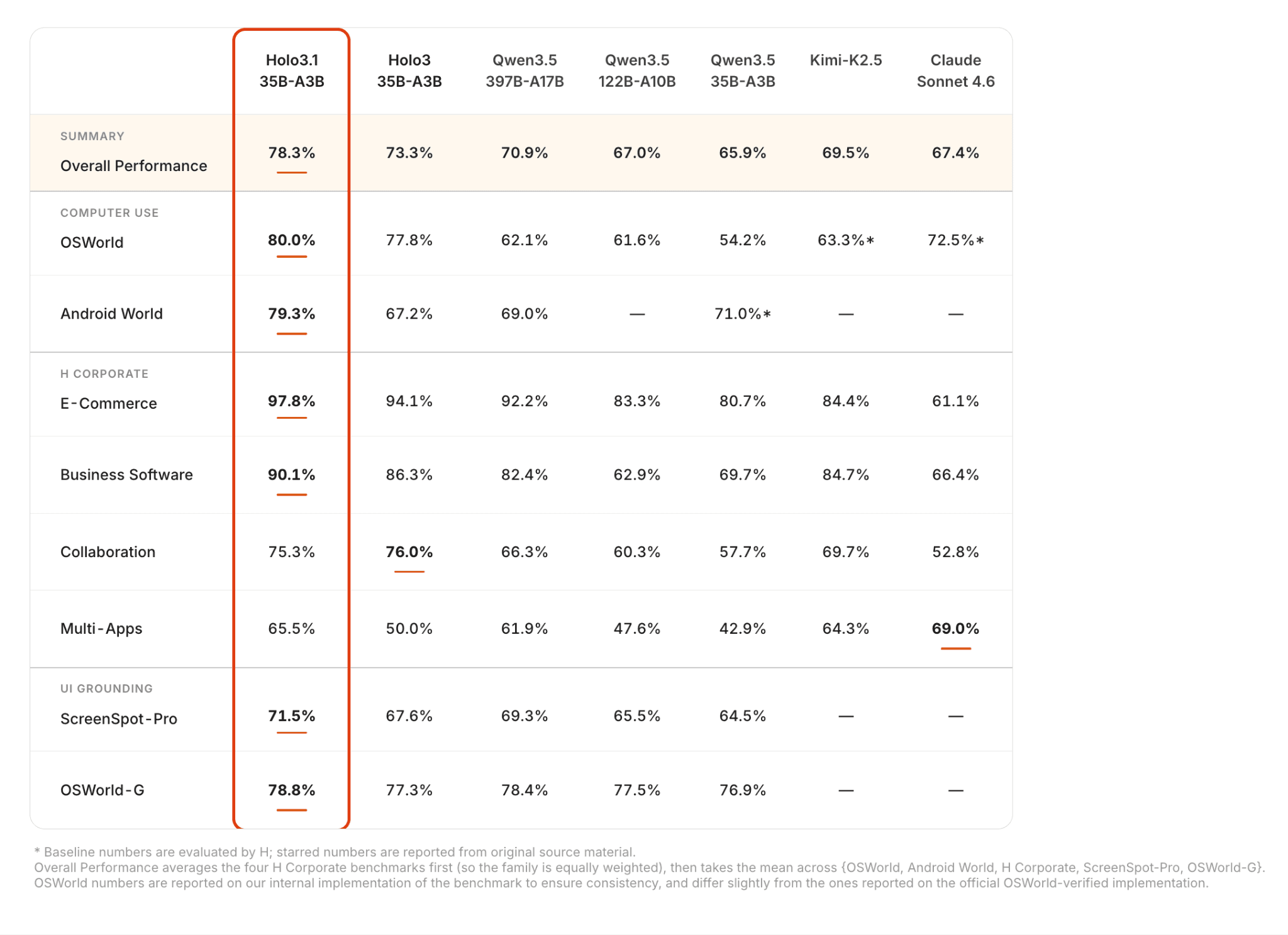
Holo3.1 expands Holo3's capabilities beyond browser and desktop control, delivering major gains on mobile environments. On AndroidWorld, our 35B-A3B model improves from 67% to 79.3%, while the smaller 4B and 9B variants improve from 58% to 71%.
Cross-Harness Performance
To better support teams deploying Holo inside third-party agent stacks, Holo3.1 introduces native support for function-calling protocols in addition to the structured JSON outputs already available in Holo3.
Across OSWorld and our internal benchmark suite covering e-commerce, business software, and collaboration workflows, function-calling and native execution now achieve near-parity performance. Holo3.1 also delivers more than a 25% improvement over Holo3 when evaluated inside our Holotab product harness.
Smaller sizes for cost-performance tradeoff
To further enable local and on-device inference, we are also releasing new model sizes including small models (0.8B, 4B, 9B) for cost-effective and private deployment, in addition to the larger 35B-A3B model for state-of-the-art performance.
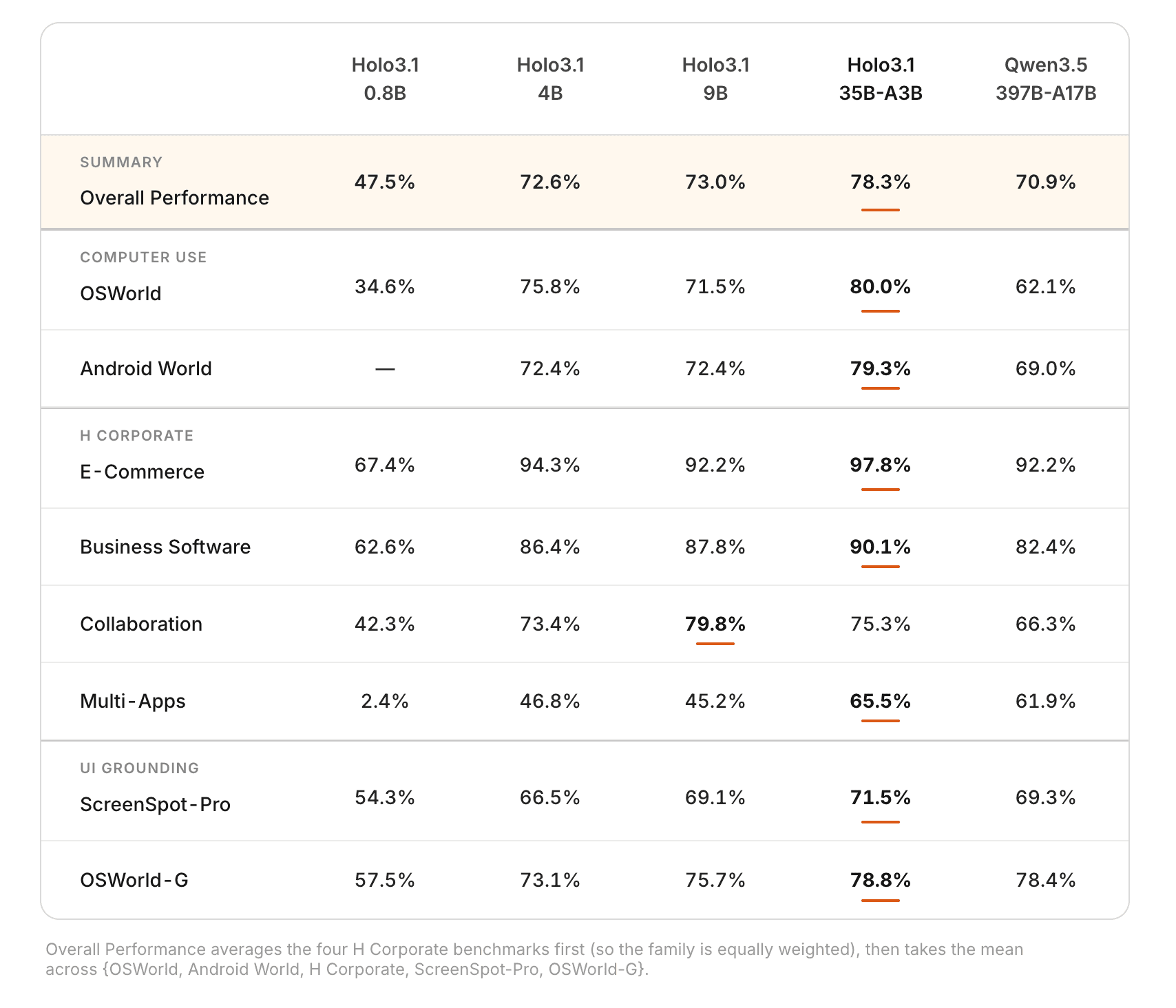
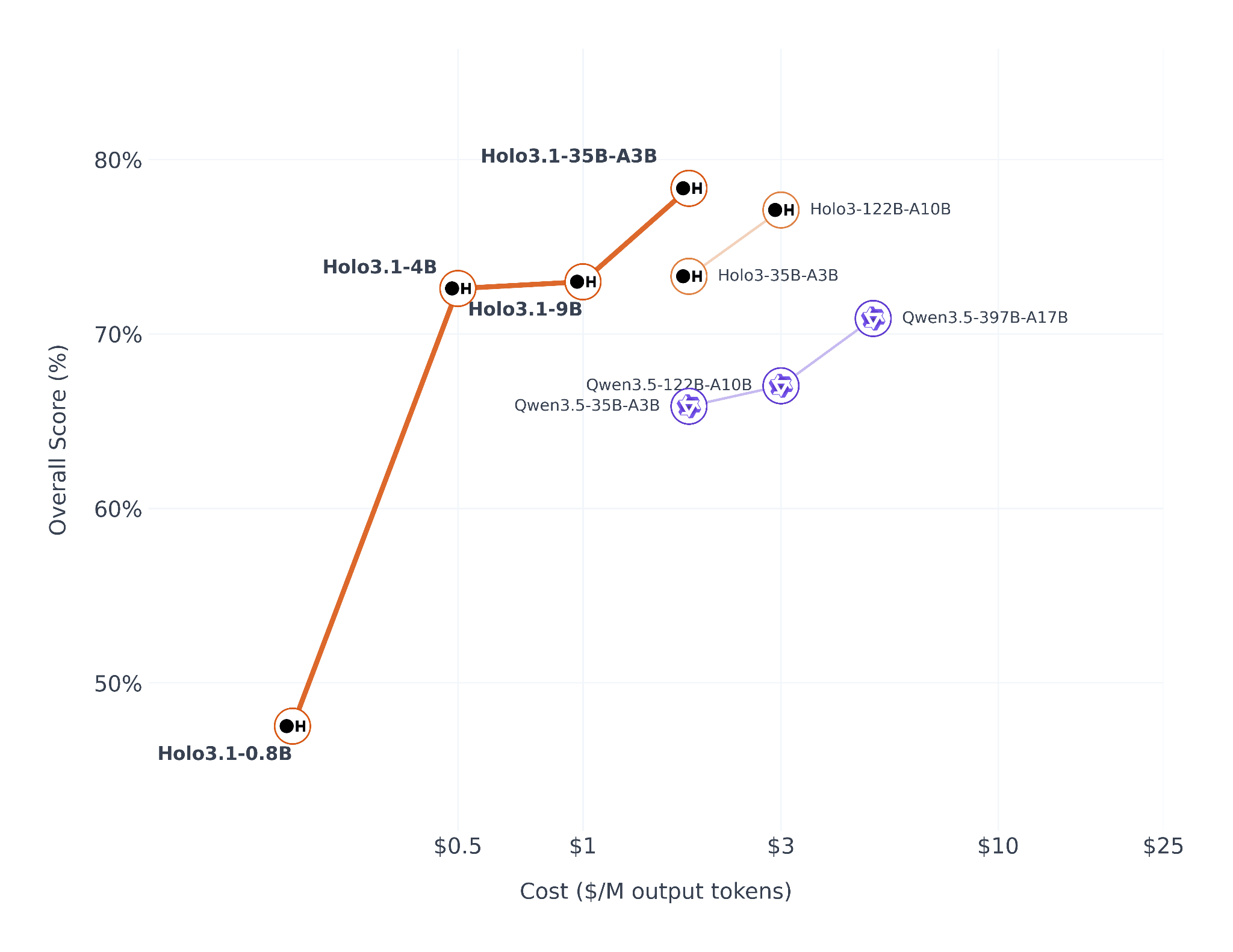
Pareto plot of performance vs cost for Holo3.1 and Qwen 3.5 families. Overall Performance averages the four H Corporate benchmarks first (so the family is equally weighted), then takes the mean across OSWorld, Android World, H Corporate, ScreenSpot-Pro and OSWorld-G.
Fast & Local Inference
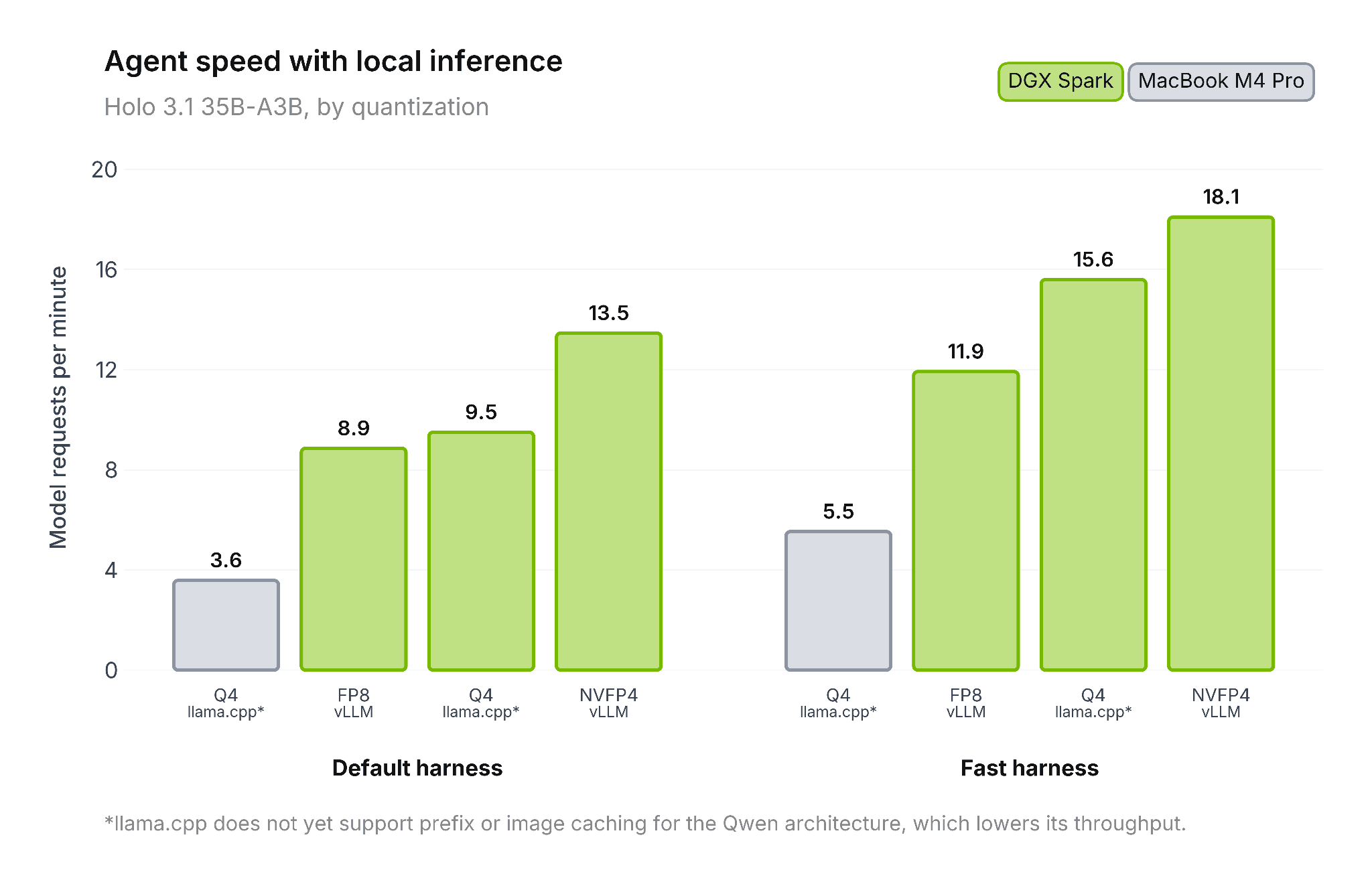
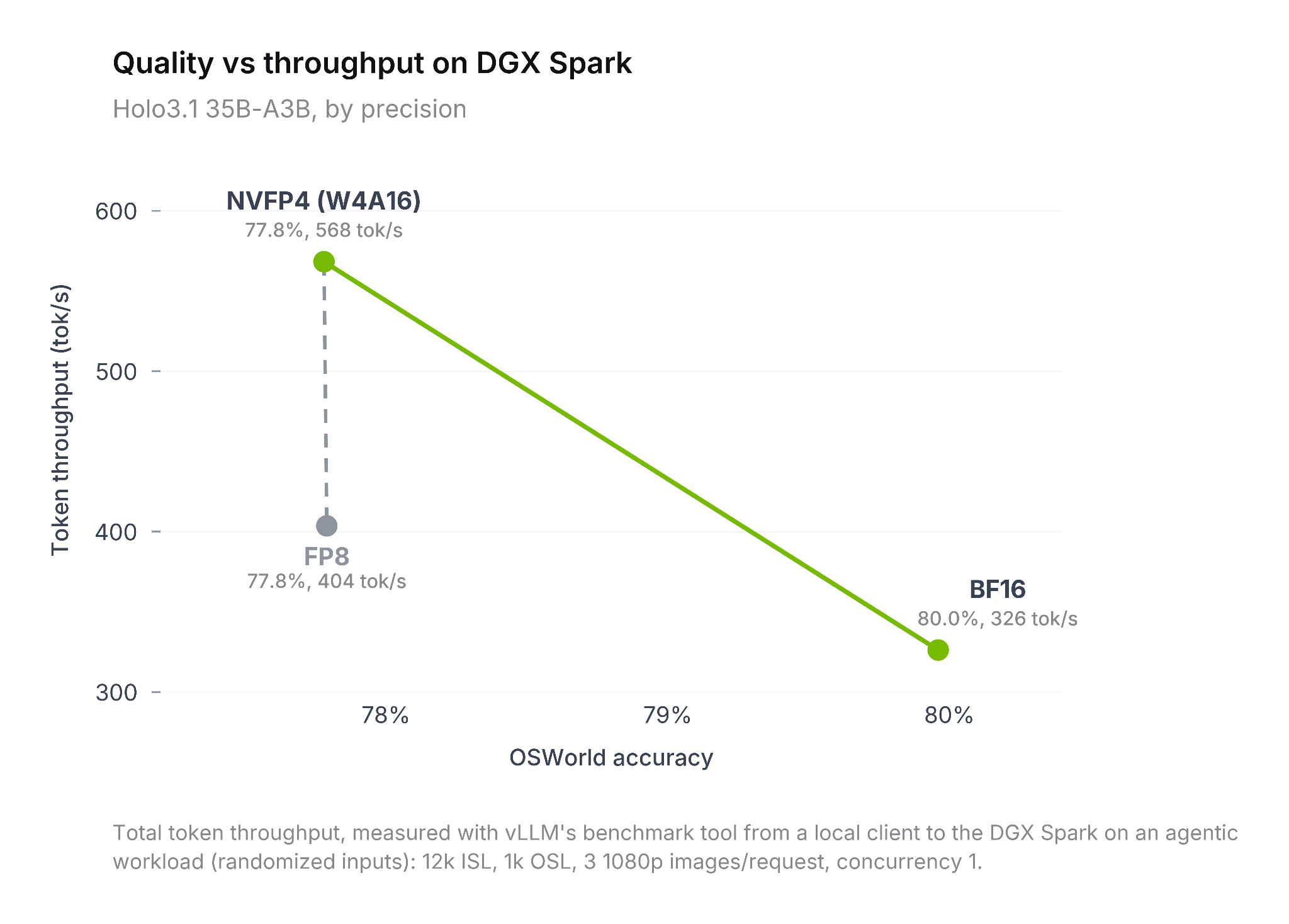
This is our first release to ship quantized weights. We’re starting with 35B-A3B checkpoints, available in FP8, Q4 GGUF, and NVFP4. For NVFP4, we used NVIDIA's Model Optimizer in a W4A16 configuration. These checkpoints enable fast local inference for Computer Use Agents with little to no degradation in model performance - FP8 and NVFP4 achieve the same OSWorld scores, just ~2 points under the full precision BF16 checkpoint. The speedups are substantial: on DGX Spark, NVFP4 W4A16 delivers 1.41× the total token throughput of FP8 and 1.74× that of BF16.
Towards Local Agents on Consumer Hardware
We also release Q4 GGUF checkpoints aimed at local deployment of Computer Use Agents on consumer hardware. The agent itself runs locally on a Windows or Mac machine, while the model can either run on that same machine - we include reference numbers for Apple Silicon - or on a DGX Spark on the same network. In both cases execution stays fully private and local, with nothing leaving the user's network. On Spark, agent harness optimizations we developed with NVIDIA combined with the NVFP4 quantization above deliver a compound ~2× end-to-end speedup over the FP8 baseline, cutting average step time from 6.8s to 3.3s. The chart below shows agent request rate across platforms and precisions in two modes: on DGX Spark, vLLM with NVFP4 has the highest request rate in both Default and Fast modes, followed by Q4 GGUF and then FP8. These improvements and more will land in an upcoming desktop agent harness.